
Superb Owl(s)
Misread, Mispriced, Misunderstood

My favorite thing is the “Aha Moment”.
When you consume the volume and range of content I do, my brain often looks like, to quote Genesis … A Land of Confusion.
I’ve skimmed a thousand headlines
Drowned in endless podcast timelines
Every voice is shouting loud
So many books I should have read by now
They say, “Just log off, you’ll be fine”
“Mute the noise, reclaim your mind”
But the thoughts are bubbling behind my eyes
Still burning long after midnightCan’t you see this is a land of confusion?”
- Genesis (with some artistic interpretation)
Some days, it all just feels like noise. Headlines blur together, narratives flip overnight, and certainty feels impossible. These moments tend to overlap with periods of real chaos, when markets are volatile, narratives dominate, and prices move faster than understanding.
But the upside of choosing to live this way is that, every now and then, patterns begin to emerge. And more often than not, that’s when the most interesting signals appear… That is if you’re paying attention.
Connections form between things that, at first glance, seem unrelated. Or unusual. (Okay… often unusual.) But when I sit with them long enough, the picture shifts.
The picture hasn’t changed.
Only the angle has.
If it works, you may notice something you hadn’t seen before.


A Superb Owl
The Super Bowl is this weekend. The headline event. The thing everyone is supposed to be paying attention to.
The New England Patriots and Seattle Seahawks will battle for the Lombardi Trophy on Sunday.
But every year around this time, something else reliably shows up in internet culture: an influx of stories about Superb…Owls?
Yes this kind:

Owls are Sublime! Sensational! Stunning! …. Supurb!
So why does this happen?
Because one small typo is all it takes. Search for Super Bowl content, miss a letter, and suddenly your results are filled with owls instead. And rather than correcting the mistake, the internet collectively decided to lean into it.
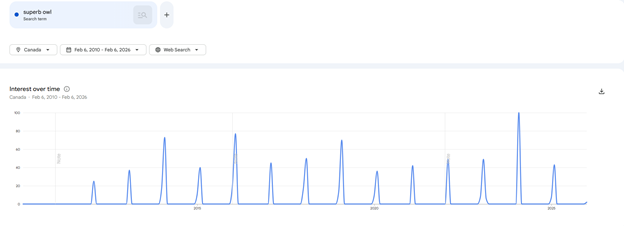
What began as a misspelling, or a meme, or who knows what, has evolved into a recurring cultural phenomenon. Each year, people flood the internet with photos of owls in the lead-up to the Super Bowl. A subreddit called r/Superbowl, an online gathering place for owl lovers, now has hundreds of thousands of members. With mentions in TV shows from Jeopardy! to What We Do in the Shadows, it is clear that the superb owl has … landed.
What started as a mistake was taken as an opportunity.
As Tate Mason, director of the World Center for Birds of Prey (iconic job title), once put it: when people started searching for the “superb owl,” they didn’t just find a meme, they found an entirely new way into learning about the birds themselves. This weekend the center is hosting an event called Superb Owl Saturday. A typo created attention, and attention created opportunity.
Same picture. Different interpretation.
And that’s the part that matters.
What’s interesting isn’t the owls. It’s the reaction to it. Something shows up where we don’t expect it, and our first instinct is to treat it as an anomaly, or a mistake, rather than ask what changed in the environment to make it visible.
That pattern shows up everywhere. In culture. In markets. And in corporate history.
Which is why I found myself re-reading parts of Built to Last over the weekend.
Built to Last
The book’s core question is simple but important: why do some companies last for decades while others fade, even when they face the same markets, competitors, and technologies?
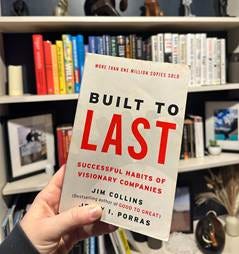
Over the last few days, that question has felt especially relevant. Between the rapidly shifting technological landscape and the recent software sell-off, I’ve been thinking a lot about some of the AI-related themes we’ve been discussing. Which led me, naturally, to Confucius:
Study the past if you would define/divine the future - Confucius
That idea sits at the heart of Built to Last. Jim Collins argues that long-term winners aren’t defined by charismatic leaders or a single great product. They’re guided by strong core values and a clear sense of purpose, organizations designed to outlive any one strategy, CEO, or business cycle.
Seemed topical.
One passage, in particular, stood out.
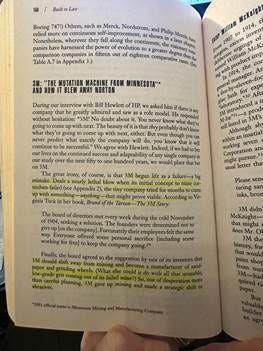
“The great irony, of course, is that 3M began life as a failure—a big mistake. Dealt a nearly lethal blow when its initial concept to mine corundum failed, the tiny company tried for months to come up with something—anything—that might prove viable.
The board of directors met every week during the cold November of 1904, seeking a solution. […]
Finally, the board agreed to the suggestion by one of its investors that 3M should shift away from mining and become a manufacturer of sandpaper and grinding wheels. (What else could it do with all that unusable, low-grade grit coming out of its failed mine?) So, out of desperation more than careful planning, 3M gave up mining and made a strategic shift to abrasives.”
For most companies, this kind of failure would have been devastating, and possibly fatal. Instead, 3M pivoted. The company relocated its headquarters and transformed itself from a mining operation into a manufacturer of abrasive products.
“What else could it do with all that unusable, low-grade grit coming out of its failed mine?” – Jim Collins
That decision turned out to be revolutionary.
3M didn’t survive because it guessed right. It survived because it built systems that allowed it to adapt when it guessed wrong.
3M’s leadership went on to foster a culture of innovation and scientific discovery that became foundational to the company’s longevity. One of my favorite examples is the “15 percent rule,” which allowed scientists to spend 15% of their time on independent projects. Many of 3M’s most recognizable products emerged from this freedom—Sasheen ribbon, Tartan Track and Turf (the first artificial running track), and the original project that inspired the 15% rule. … Scotch tape.
A setback that once appeared existential became the best thing that ever happened to the company.
And it does make you wonder: if that original mine had been successful, would we have Scotch tape? Or, heaven forbid, Sticky Notes?
Sometimes endurance isn’t about getting it right the first time. It’s about building something resilient enough to survive being wrong.
Software is Dead, Long Live Software
Which brings us to today.
Over the past week, share prices across software, media, and IT companies have declined rapidly and, in many cases, unfairly. The move has largely been attributed to the release of the latest AI tools from Anthropic, tools the market has interpreted as an existential threat to many if not all software companies.
At the center of the anxiety is Claude Cowork, a desktop agent currently available on Mac. Agents use large language models to execute a series of complex tasks from a single prompt. When they work, they feel magical.
And when something feels magical, markets tend to jump to conclusions, leaning on narratives before evidence has time to accumulate.
Today the story is extreme. Software is finished. Entire categories are obsolete. A single technological shift is assumed to compress decades of business models into obsolescence.
Again, it’s framed as a disaster, a one-off, an existential threat… Or is this what adaptation looks like at first glance?
I was reading Death of Software. Nah, published by a16z’s Steven Sinofsky, where he compares today’s AI moment to earlier transitions: the move to personal computers and graphical interfaces, the rise of online retail, and the pivot to streaming.
His argument is that AI may change what we build and who builds it, but not how much needs to be built. If anything, it points to a future with significantly more software, not less.
Looking to the past, moments like this are rarely linear. Some people think the future is less than five years away (The Adolescence of Technology), some are convinced it’s decades off, some believe it may never arrive at all. These transitions are uneven, slow, and messy.
In these environments of experimentation and adaptation that doesn’t mean that the legacy systems that still run the world go away.
Markets, however, don’t like messy. At least certainly not this week.
The infamous Mr. Market has appeared to have reached the conclusion that: software is dead.
But if history is any guide, that conclusion won’t age well.
Now and in the future there will likely be a number of companies trading at prices that imply far more disruption than what is a rational reality.
Which brings us to the rarest of birds the Blue Owl.
Blue Owl(s)
Blue Owl Capital Inc. is an alternative investment asset management company (unfortunately we are no longer talking about supurb birds)
The company reported earnings this week. And reading through the call, it’s hard not to notice how different the company’s reality is from how the market has been acting.
When asked directly about AI-driven disruption in software, and whether it was creating hidden credit risk, management’s tone was if anything… calm.
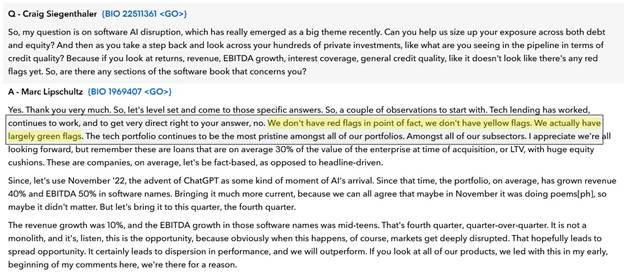
Despite the intensity of the headlines, they reported no deterioration across the core fundamentals: revenue, EBITDA growth, interest coverage, or overall credit quality. In fact, management said that: There were no red flags. No yellow flags. What they described instead were “largely green flags.”
The company also highlighted that since November 2022, the advent of ChatGPT, the software portfolio has continued to grow. Even in the most recent quarter, growth remained positive.
The company framed software not as a “monolith” under threat, but as a set of differentiated businesses, where AI creates opportunity, not destruction.
“Software is an enabler. And the best companies, what we are seeing that are embedded in that position and have data moats and operating environments like health care, financial services with zero tolerance for risk environments, regulatory limitations. We’re seeing is they’re the ones of the adopters of AI. They’re the ones that are then turning around and saying, here, I can offer you an agentic solution to replace some of your human costs, some of your labor costs, by integrating these capabilities into the software I already have resident in your system and fully integrated into your daily behavior. So we understand the generic there are certain parts of software that are vulnerable, and they are.” - Blue Owl Earnings Call
What stood out to me wasn’t just that Blue Owl was willing to say this out loud, it’s that they’re not alone.
Thomson Reuters CEO Steve Hasker echoed a similar view, noting that the recent plunge in software and data providers “represents anxiety, not fundamentals.” In a recent interview, he added that the company’s confidence in its AI strategy and its position within the broader ecosystem is actually increasing.
“Our bet is that we can take our content, our expertise, and our leadership in research and know-how and use that to drive a leadership position in legal AI-driven workflows. […] And our bet is that others cannot come the other way.” - Thomson Reuters CEO Steve Hasker
Taken together, these aren’t isolated defenses. They’re consistent signals from operators embedded in the businesses themselves. Software isn’t a single thing reacting uniformly to AI, and despite headline volatility, the underlying data points to adaptation, durability, and opportunity, not deterioration.
Same Owl, Different Forest
So what now?
The environment we’re operating in today has changed. That part is true.
But it hasn’t changed terminally, at least not in my opinion.
History suggests the question we should be asking isn’t who avoids disruption. Disruption is unavoidable. The better question is: who is structured to absorb it?
3M didn’t survive because it predicted the future correctly. It survived because it built systems that allowed it to adapt when its original thesis failed.
Software is facing its own version of that moment. New tools are arriving quickly, narratives are forming faster, and prices are adjusting before understanding has fully caught up. That discomfort is real. But discomfort isn’t the same thing as destruction.
The market is full of suburb owls right now. Things showing up where we didn’t expect them. Business models being questioned not because they’ve stopped working, but because the setting around them has shifted.
The question isn’t whether disruption is real. It’s whether we mistake adaptation for danger, or recognize it as information.
Because in periods like this, the opportunity rarely lies in predicting the next breakthrough. It lies in recognizing which systems are resilient enough to survive being wrong, and strong enough to benefit from what comes next.
Sometimes that means paying less attention to the Super Bowl, and more attention to the Superb Owl.
Company Specific Updates:
Webster Financial Corp- announced an agreement under which it will be acquired by Banco Santander for $48.75 in cash and 2.0548 Santander American Depository Shares. The per share consideration of $75.59 represents a 16% premium to Webster's 10-day VWAP.
Deckers - reported strong Fiscal Q3 results yesterday and raised its revenue growth guidance. Management is executing well by operating the company as if it were a luxury business by limiting inventory in the wholesale channel which is translating into pricing power and sell through outpacing sell in.
MDA – link - Bloomberg reports that MDA is aggressively recruiting global talent as defence spending fuels a new space boom. Governments, particularly in Canada and allied countries, are pouring money into satellites, robotics, and space-based intelligence for military and national-security uses, sharply increasing demand for highly specialized engineers and scientists. MDA is benefiting from major defence-linked contracts including military satellite communications and surveillance systems but faces intense competition for skilled workers in a tight global labour market. To keep pace, the company is expanding hiring beyond Canada, positioning itself as a key player in a rapidly militarizing space economy where talent shortages risk becoming a bottleneck to growth.
Sylogist- OneMove sent a letter to the board requesting special shareholders meeting to replace the chairman and two other board members.
Exchange Income – has acquired Florida-based commercial aviation aftermarket company, MACH 2, for US$43M (US$34M in cash and US$9M in stock). EIF says that MACH 2 does not target the regional segment of the market, so there is < 5% overlap with their Regional One business.
Dye & Durham – has filed their FY25 and Q1 FY26 financial statements, with revenue and adjusted EBITDA largely in-line with what was communicated by the company when they released preliminary results this past December. DND says that their reconstituted Board can now work towards a comprehensive strategic plan and they expect to outline their full strategy “in the coming weeks”. They did not declare a dividend, saying they would defer such a decision until strategic planning is complete. DND’s AGM/SGM will be on March 4th.
5N Plus Inc. - Announced that its wholly owned subsidiary AZUR SPACE Solar Power will further expand its space solar cell production capacity by about 25 % in 2026, adding to previous increases of 30 % in 2025 and 35 % in 2024 to meet strong demand for advanced solar technology used in satellites and space missions. The new capacity is expected to come online gradually starting in the second half of the year, with the company leveraging existing space and process improvements rather than major new investments. This continued expansion reflects a robust order backlog and growing customer needs driven by trends like AI, connectivity, and space observation/security applications
On Friday 5N Plus also announced an $18 million investment from the U.S. Department of Defense to expand U.S. germanium refining capacity at 5N’s Utah facility by approximately 7x.
Pender Events + Publications
The Pender Alternative Select Equity Fund and Pender Corporate Bond Fund were recognized for consistent outperformance on a risk-adjusted basis, reflecting disciplined investment processes and resilient results in a dynamic market environment. This recognition marks the first FundGrade A+ Award for one of our liquid alternative funds, and the seventh time the Corporate Bond Fund has earned this distinction. Read the press release here: https://bit.ly/4rAI6UP
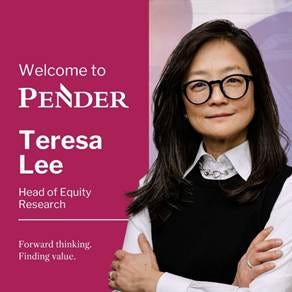
We’re pleased to announce that Teresa Lee has joined Pender as Head of Equity Research. She will also work with David Barr on the Pender Global Small/Mid Cap Equity Fund. Teresa brings over 25 years of investment management experience, with a focus in small-cap investing. She previously led small cap, all cap, and high-conviction strategies at Sionna Investment Managers where she spent 16 years, becoming Co-CIO in 2015. We believe that small cap equities are an area with significant potential to add value to client portfolios and Teresa’s arrival strengthens Pender’s active, fundamentals-driven small-cap investing capability, adding depth and breadth to our equity research and investment process. Read the full announcement here: https://bit.ly/3LTlP5k
Upcoming Webinar: Credit Market Update - Join Justin Jacobsen, Portfolio Manager, for a discussion and update on the Pender Alternative Absolute Return Fund. Justin will cover: Reflecting on markets and the Fund positioning in 2025, Today’s markets and valuations, Looking ahead and positioning for 2026. Date: Wednesday, February 11, 2026 Time: 10am PST. Register: https://bit.ly/4a3SAoj
Pender Growth Fund Portfolio Company, General Fusion, Announces a Proposed Business Combination – link - Pender Growth Fund’s portfolio company General Fusion has entered into a definitive agreement to merge with Spring Valley Acquisition Corp. III, a SPAC, which is expected to result in General Fusion becoming a publicly traded company on the Nasdaq under the ticker “GFUZ”. The proposed transaction implies a pro-forma equity value of about US $1 billion and is anticipated to close in mid-2026, subject to approvals. If completed, the deal is expected to increase Pender Growth Fund’s NAV and provide capital to advance General Fusion’s fusion energy technology program. The move reflects confidence in fusion’s potential role in future energy systems and aligns with long-term investment themes around the energy transition.
Insights at the intersection of defense, geopolitics, and long-term investing - At Pender, our equity team focuses on identifying opportunities at the intersection of sector and capital cycles, structural change, and market inefficiencies. Our core themes include Enterprise Software, AI, the Energy Transition, and the evolving geopolitical environment — with this paper exploring Defense as a key expression of today’s geopolitical shift, supported by a companion podcast featuring the Retired Vice Admiral Mark Norman.
The Intelligence Wars: Defense Spending, Technology, and the Global Realignment - White Paper - Global defense spending is entering a new era, defined by intelligence, technology, and industrial resilience. As nations rearm and supply chains adapt, trillions of dollars are being deployed. For Canada, this represents a strategic shift as well as an investment opportunity as defense spending accelerates and industrial capacity expands. Across themes — from the energy transition to digital infrastructure to defense innovation — governments, corporations, and investors are re-evaluating where value is created and protected in the new geopolitical climate. At Pender, we see this as part of a broader capital cycle — one in which structural tailwinds, innovation, and disciplined capital allocation will determine the long-term winners in an evolving global landscape.
Podcast – link - In this episode of the Pender Podcast, Laura Baker, Associate Client Portfolio Manager, is joined by Retired Vice Admiral Mark Norman to discuss Canada’s evolving defense landscape and why it matters in today’s geopolitical and investment environment. Drawing on decades of military leadership and policy experience, the conversation explores defense readiness, procurement challenges, Arctic security, and the growing intersection between national security, technology, and capital markets.
Pender Credit Opportunities Fund Q4 - Parul Garg’s commentary reflects on Q4 and includes an outlook for 2026. The Fund was up 13.7% for the year; the benchmark returned 7.3% for the same period. A consistent, bottom-up approach helped turn dislocations into opportunities. We are thinking about risk and return through the lenses of fundamentals and valuation. “We believe the opportunity set for our investment style and philosophy is deeper and broader than it has been in some time even with major market indices sitting near record highs and valuations remaining above normal.” Read the full manager’s commentary: https://bit.ly/4qaYkCX
Pender Market Insights – In this edition, Greg Taylor explains how momentum defined 2025, with global equity markets delivering a third consecutive year of strong gains and finishing the year at all-time highs, despite bouts of volatility, policy uncertainty, and geopolitical noise. Looking ahead to 2026, Greg is tracking where rate policy, geopolitics, and a potential rotation toward undervalued international markets may shape the next phase of returns. As the market enters the new year with a healthier, more diversified foundation, the opportunity set appears wider but selectivity remains key. Read the full commentary here: https://bit.ly/4qN8sCH
Podcast Episode: Deploying Generative AI and Other TMT Predictions – link - We are pleased to welcome back Duncan Stewart, Director of TMT Research at Deloitte Canada, for Pender Ventures’ annual Technology, Media, and Telecommunications (TMT) update. Hosted by Maria Pacella, Managing Partner at Pender Ventures, this wide-ranging conversation explores Deloitte’s 2026 TMT Predictions and what they mean for investors, operators, and policymakers. Duncan shares insights on AI-driven economic growth, data center infrastructure, agentic AI, robotics, energy constraints, and the narrowing gap between AI promise and reality.
Webinar Replay Now Available: Credit Markets Outlook and Top Ideas for 2026. Geoff Castle, Lead Portfolio Manager and Emily Wheeler, Portfolio Manager share their perspective on the credit landscape heading into 2026, drawing on the Pender Corporate Bond Fund’s recent performance to discuss where risks are building and where opportunities may be emerging. In this session, the Fixed Income team covers: Outlook for credit markets in the year ahead, Key risks investors should be watching, Top ideas influencing portfolio positioning for 2026. Watch the webinar replay here: https://bit.ly/4sAvgHu
Market Snacks
Peloton Down Over 21%, on Pace for Largest Percent Decrease Since February 2024 – the company is down 24.27% year-to-date. The company reported Q2 results, with revenue decreasing on falling subscription numbers as the company projected further declines going into the third quarter. The fitness company also said Thursday that Chief Financial Officer Liz Coddington was leaving to join Palmetto, the solar energy company. The company said Coddington will stay at Peloton through March, and that it had launched a search for her successor.
Molina, Centene Fall on Concerns About Medicaid Business - WSJ - Investors are sending down shares of Medicaid-focused health-insurance companies, with a 28% plunge for Molina Healthcare and a 5% drop for larger rival Centene. Managed-care investors are selling, after a years-long pattern of unexpected cost spikes and margin collapses across health insurance companies and lines of business. They are easily spooked by hints that more such surprises might be in store, and the Medicaid plans have been particularly challenging.
The Stocks That Punch Above Their Weight in the Dow - WSJ - The top five stocks by market cap in the 30-stock Dow are Nvidia, Apple, Microsoft, Amazon and Walmart. They would represent 69% of the index if it were market-cap weighted. As it stands under the Dow’s methodology of giving more weight to higher priced stocks, the top five are Goldman Sachs, Caterpillar, Microsoft, Home Depot and Amgen. They make up about 35% of the index.
Revenge of the Real-Barrons.com - Some of the market’s most boring stocks are having their best start to the year in decades. Oil prices might have fallen sharply, and the world appears awash with excess crude, but Exxon is up more than 20% this year and Chevron has gained 16%. Consumers might be tightening their belts, and pushing back against incessant price hikes amid stubbornly high inflation, but the staples sector has booked its strongest January gains since 1997. Costco is up 15% and Walmart crossed the $1 trillion market cap threshold earlier this week. The rotation from tech into “real” has been good for one of the market’s biggest issues in 2025: a lack of breadth. Up until November, around 88% of S&P 500 performance for the year came from the top 100 stocks on the index, according to S&P Dow Jones Indices. Since then, the “bottom” 400 names have driven 76% of the benchmark’s gains.
Justice Department Casts Wide Net on Netflix’s Business Practices in Merger Probe -WSJ -The Justice Department is investigating whether Netflix has engaged in anticompetitive tactics as it probes the streaming giant’s proposed acquisition of Warner Discovery’s studios and HBO Max streaming service, according to a civil subpoena viewed by The Wall Street Journal.
Dow Jones Industrial Average Hits 50000 for First Time - WSJ - The Dow Jones Industrial Average hit 50000 for the first time on Friday, the latest milestone in a yearslong run in which the U.S. economy has muscled past its rich peers and snapped up investment the world over. “We don’t think that the U.S. opportunity is over by any stretch of the imagination,” said Chris Hyzy, chief investment officer of Bank of America Private Bank and Merrill.
Macro Musings
Warsh’s Confirmation As Fed Chair Will Be Messy. Here Are the Consequences. - President Donald Trump is locked in a game of chicken with Senators who want to see the Justice Department drop its inquiry into Fed Chairman Jerome Powell before confirming Kevin Warsh as his successor. While there’s little doubt Warsh will get the job eventually, any delay could have lasting implications for Trump’s ability to pressure the Fed.
Macklem says economy undergoing structural change, plays down chance of further rate cuts
Carney’s new auto-industry policy hinges on how badly carmakers want to sell in Canada - link
Ottawa is working on bringing South Korean automakers to Canada. The feds signed a memorandum of understanding with South Korea to bring more auto manufacturing to Canada. Both South Korea and Germany — the two finalists to land a Navy submarine contract — have been asked by Ottawa to make auto manufacturing pledges as part of their bid. (Globe and Mail)
U.N. faces “imminent financial collapse.” United Nations Secretary-General Antonio Guterres says the organization could run out of cash by July because of US$1.57 billion in unpaid dues. Guterres did not name which countries haven’t paid up, but the U.S. has publicly pulled funding from dozens of U.N. initiatives. (Reuters)
EU and India sign trade deal. The new agreement — dubbed “the mother of all deals” — will allow the free trade of most goods between India and the European Union, which together make up 25% of global GDP. Under the terms of the deal, professionals will be able to move and work more easily between India and Europe. (BBC)
Technology Today
It’s the Biggest Year Ever for Super Bowl Betting - Barrons.com - While online sports betting is still illegal in 18 states, including California and Texas, prediction markets Kalshi and Polymarket are available nationwide. If betting on the game itself isn’t of interest, prediction markets also offer contracts related to the halftime show, such as what songs will be performed or how many minutes the show will run. Sportsbooks in most states require bettors to be 21 years old, but anyone over the age of 18 can trade on a prediction market.
Roblox Seen With Strong Safety Feature Rollout - Roblox’s rollout of a new safety feature has been strong, going largely as planned with about 45% adoption so far. The tool scans users’ faces to estimate their age, and is required for accessing chat features on the platform. Based on its age-check data so far, Roblox saw its age distribution skew slightly younger than its previous estimates, which could give proof that it has farther to scale with higher-age cohorts than originally thought, the analysts say. The safety rollout has dented engaged hours growth by a mid-single-digit rate, an effect that should moderate, they say.
EU says TikTok needs to drop “addictive design” Link- The European Commission announced preliminary findings that TikTok’s addictive design, including features like infinite scroll, breaches the Digital Services Act and fails to protect users adequately. Regulators said TikTok’s Daily Screen Time warnings are “easy to dismiss” and its parental controls require too much effort, so the company must “change the basic design of its service.”
NASA will now allow astronauts to take their smartphones to space Link
Google hints at big AirDrop expansion for Android “very soon” Link
China’s humanoid robot makers pivot from ‘body’ to ‘brain’ as commercial race heats up Link
Zuckerberg on why Meta should do less safety research: ‘Apple doesn’t study any of this’ Link
AI of the Tiger
Apple loses four AI researchers and Siri executive to rivals Link - Apple has lost four artificial intelligence researchers and a senior Siri executive in recent weeks, with the staff leaving for competitors including Meta Platforms and Google DeepMind.
Anthropic launches Claude Opus 4.6 Link- Anthropic released Claude Opus 4.6, its newest model, featuring a 1M token context window in beta — a first for the company’s Opus-class models — along with stronger coding and agentic task performance. New developer tools include adaptive thinking, four effort levels, context compaction for longer-running agents, and agent teams in Claude Code that let multiple agents work in parallel on tasks.
Meta tests a standalone app for its AI-generated ‘Vibes’ videos Link - Meta confirmed it is testing a standalone app for Vibes, its AI-generated short-form video feature that lets people create, share, and browse AI videos in a dedicated feed.
Goldman Sachs is tapping Anthropic’s AI model to automate accounting, compliance roles Link
Thomson Reuters CEO says plunge in software stocks driven by anxiety, not fundamentals - link
Google unveiled Project Genie, an AI-powered game creation tool that generates playable virtual worlds from simple inputs, raising fears of disruption to traditional game engines
Crypto Corner
How Crypto ETFs Could Make the Bitcoin Selloff Even Worse - For the past two years, exchange-traded funds have been one of the best things to happen to Bitcoin, collecting nearly $60 billion since early 2024. That’s when the Securities and Exchange Commission first permitted ETFs to hold the crypto directly. However, in the past four months, Bitcoin’s price has tumbled more than 40%, to around $68,000. The pessimism toward crypto is starting to show up in fund flows for Bitcoin ETFs. Investors have yanked roughly a net $1 billion from the funds in the past week alone. If those ETF outflows were to accelerate, perhaps climbing into the tens of billions, the departing investors could put extra selling pressure on Bitcoin’s price. Will Bitcoin’s losses start a stampede for the exits in these funds? Not necessarily. While Bitcoin generally behaves like a speculative risk asset, the new breed of Bitcoin ETFs were frequently pitched to investors not as lottery tickets, but as vehicles of diversification. BlackRock itself, parent of the iShares Bitcoin ETF, has argued for allocating up to 2% of conventional stock/bond portfolios to Bitcoin. Firms like Morgan Stanley, Fidelity, and Bank of America’s Merrill Lynch have taken similar positions.
U.S. Bitcoin Reserve Loses Nearly $5 Billion in Value After Crypto Wipeout - Barrons.com - It’s been nearly a year since President Donald Trump signed an executive order establishing a “strategic Bitcoin reserve” and vowed that the government would never sell the cryptocurrency on his watch. When Trump signed the order in March 2025, government officials estimated the U.S. owned about 200,000 Bitcoins, with a market value of $18.5 billion at the time. The value of that stash is now about $4.7 billion dollars less. Despite Bitcoin’s continued descent, Trump officials are showing no signs of abandoning the reserve, pointing out that in the past several years, Bitcoin’s price is still up dramatically.
Bitcoin Price Rises After Biggest Rout Since 2022 Crash - WSJ
Energy Transition Today
The Converted Golf Club That Helps Data Centers Get on a Greener Course - WSJ – A former golf course in Gainesville, Virginia, is now deliberately overgrown, bursting with trees -- from sycamore to sweet gum and black cherry -- wildflowers and other plants to create what’s known as a nutrient bank, where companies can buy credits to offset the harm they cause to the environment at their sites nearby. Nutrient bank lands in Virginia are overseen by a state environmental regulator and can’t be built on in the future. That’s especially significant in an area of the state now dubbed “Data Center Alley”.
Carbon capture developers press ahead in Louisiana despite permitting pause - The head of southeast Louisiana’s economic development agency played down the impact of Gov. Jeff Landry’s (R) moratorium on applications for CO2 injection wells.
Will soaring electricity rates kill Ontario’s nuclear expansion? - link - Future plans include what would be two of the largest nuclear plants on Earth, which will cost hundreds of billions of dollars
The Dig
Barrick Mining is pushing ahead with its plans for an IPO of its prized North American gold assets but a number of questions remain, not least around where partner Newmont will fit into things. Barrick aims to complete the IPO process by late this year, and plans to retain a significant majority interest in the assets. Just what that will look like will only be learned later.
Barrick Mining Corp. is reviewing all aspects of its 50%-owned Reko Diq copper-gold project amid deteriorating security in Balochistan, Pakistan.
Teck Resources’ CEO says Canada must do more to tap the critical minerals that offer up a “generational opportunity to reshape” the country. In a speech, Jonathan Price calls for action on three fronts. First, authorities must continue to speed up permitting for resources projects. The country must also ease infrastructure constraints, pushing rapidly for transmission lines, ports, road and rail to access vast resources often found in remote areas. Price says there is a need for public-private partnerships on strategic investment in critical minerals. Markets for some metals like germanium, antimony and gallium are too small and too exposed to manipulation to justify significant investment without a measure of government support, he says. Also, he says there are metals and minerals fundamental for defense applications and cutting-edge technologies
Rio Tinto Group is no longer considering a potential merger with Glencore PLC, as the two companies failed to agree on key terms
The UK government signed a memorandum of understanding with the US to strengthen critical minerals and rare earths supply chains through coordinated investment and policy tools
The Picks List
Food delivery is eating people’s budgets. This, from the NYT: “From her roughly $50,000 annual salary as a data processor in San Diego, Ms. Reedy, 34, spends at least $200 to $300 a week on food delivery. Ordering in has eaten away at her savings, she said, and led her to socialize less. She tips generously, but worries that the delivery drivers are poorly paid.” (New York Times)
What happens to you when you stop taking Ozempic
The secrets to longevity, as told by a 101-year old “superager.”
What makes Finland the happiest country in the world?
Scientists have created a free app called DinoTracker that uses AI to analyze and compare dinosaur footprints from millions of years ago.
The Breakroom
On Pebble Beach’s 14th Hole, a New House Lists for $45 Million -WSJ - One of the only spec houses to be built on California’s famed Pebble Beach Golf Links in decades is hitting the market for $45 million.
Why some songs are more likely to get stuck in your head.
Coca-Cola announced that it will no longer sell frozen products in Canada, with these items disappearing from grocery stores this quarter. If you’re a fan of those cans of Minute Maid frozen juice concentrate, it’s time to clear some freezer space and stock up.
What is ice boating and where can you try it out?
Mount Fuji’s famous cherry blossom festival is being cancelled because of overtourism.
Please read important disclosures at www.penderfund.com/disclaimer.
Standard performance data for Pender Funds can be found at www.penderfund.com/solutions/